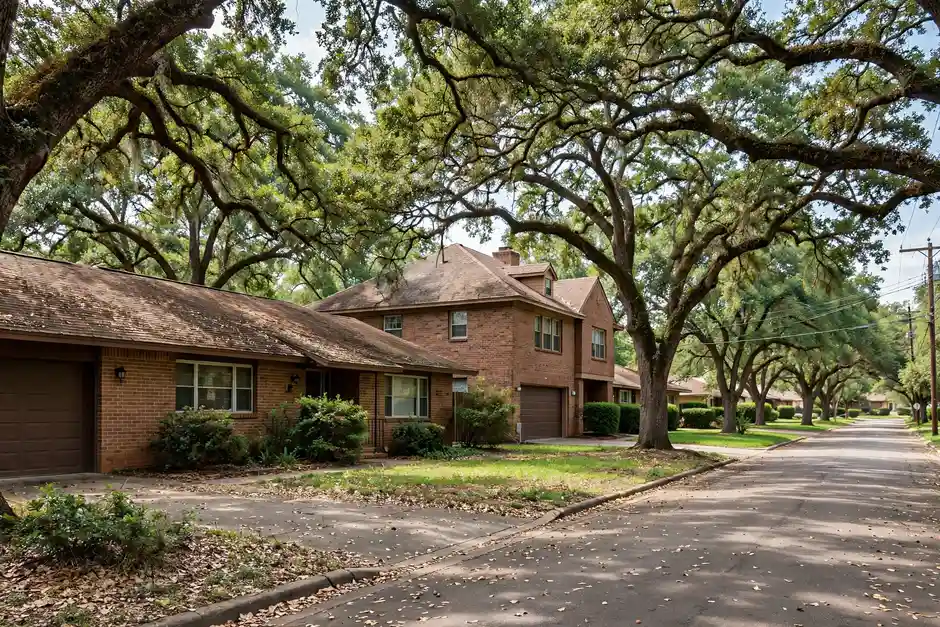
Thousand Oaks sits in the northeast of San Antonio, in the 78247 area, in the north-central residential belt between Loop 410 and Loop 1604 — near Northern Hills, Oak Park–Northwood, and Deerfield, in the part of the city the guides describe as postwar-to-1980s suburbs with Randolph Air Force Base influence. The citywide median year built is 1985, and Thousand Oaks sits right on it: a median build around 1985 to 1989, against a Bexar County median of 1990. That age is the whole story of the roof. A 1980s three-tab roof is long past its realistic 12 to 15 year life, and a 1990s architectural roof is on its second replacement by now. The dominant material is architectural asphalt shingle — the citywide default — on simple gable and hip roofs, with mature live-oak and pecan canopy overhead. There is no HOA review board here and no historic overlay. The roofing work is straightforward: read the roof’s age, check the deck, and scope the job honestly.
Explore Thousand Oaks services →
The deck is the Thousand Oaks question that younger neighbourhoods rarely have to ask. A roof that has been re-covered twice has a deck that has been nailed, patched, and weathered for forty years, and the tear-off is when its condition finally shows: soft spots at the eaves, delaminated sheathing at the valleys, and flashing that has been layered over rather than replaced. We check the deck on every tear-off and price the scope on what we find, not on what the last roof hid. Hail is the other test: the 11 September 2026 storm brought 1.5-inch hail to Kirby and the northeast side, and the 3 May 2021 storm dropped a 5.5-inch stone near Sayers on the east side. On a roof already a generation old, hail damage shows faster and recovers worse — bruised mats, granule loss, and ridge caps that fail months later. An inspection after a spring storm matters here even when nothing is leaking yet.
Juarez contracting & innovation LLC