Heat-welded seams
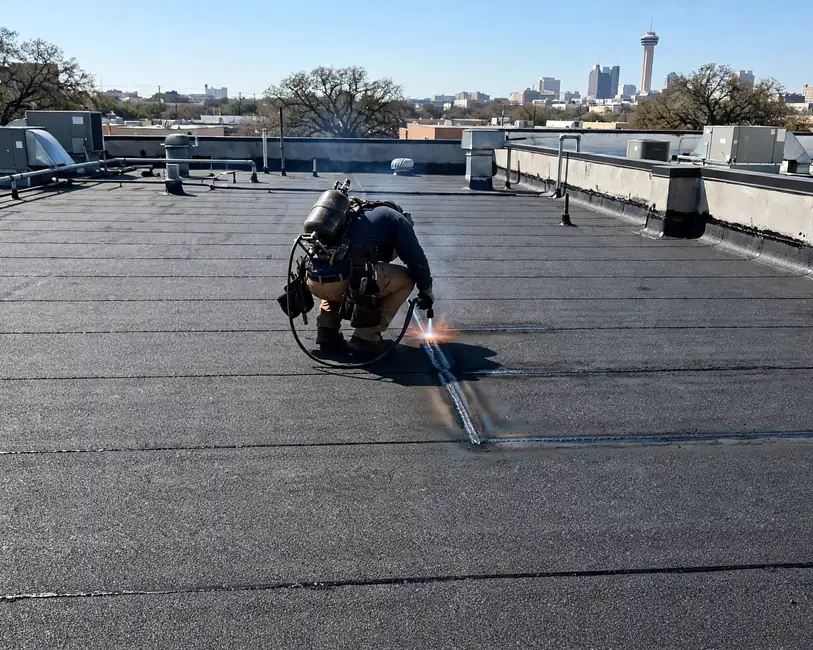
Seams are welded into a single sheet and probed as they are laid, so a weak weld is found on the day it is made, not in the next rain.
TPO is a single-ply membrane for low-slope roofs, and its strengths suit San Antonio: heat-welded seams that become a single sheet, a reflective surface that cuts the heat load, and a system built for the flat sections of mid-century modern homes and additions. Its weakness is the same as every low-slope membrane: seams fail from thermal movement, and ponding finds the weak seam. A TPO roof lives or dies on its seams and its drainage.
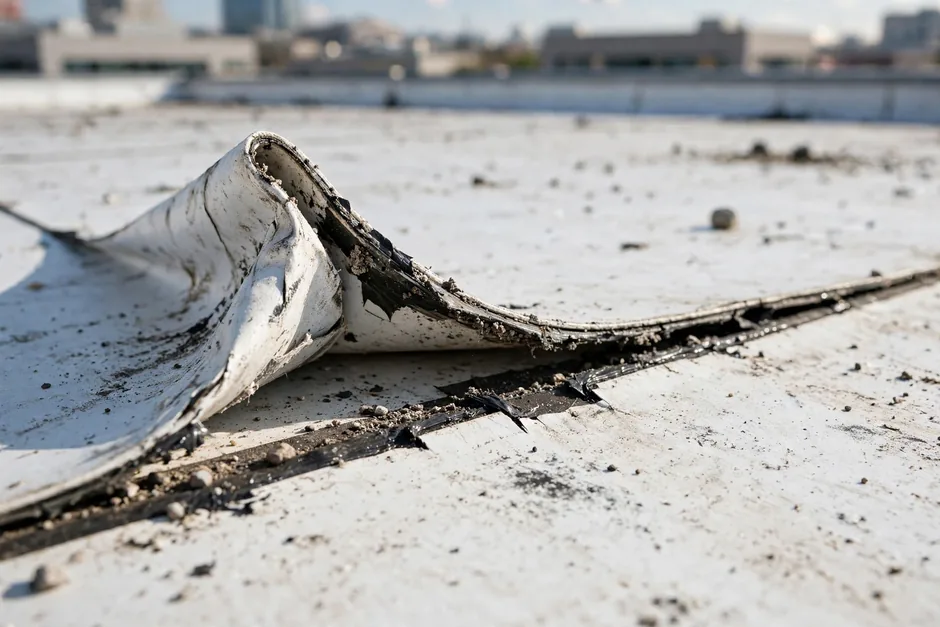
TPO goes down as a single-ply sheet, with seams heat-welded into one continuous membrane. The weld is the strongest joint on a low-slope roof when it is done right, and the weakest when it is rushed. The reflective surface matters here: a white or light TPO roof reflects the sun instead of absorbing it, cutting the heat load on the space below. Flat and low-slope membranes realistically last 15 to 25 years here, and the failure mode is seam failure from thermal movement, not the membrane wearing through.
Drainage decides the real life. San Antonio averages 32.38 inches of rain a year, with May the wettest month, and a single day has delivered 9.52 inches. A TPO roof that ponds will find its weak seam. We design slope to drain, size drains and scuppers to the roof area, and probe every seam as it is laid, so a weak weld is found on the day it is made, not in the next rain.
A TPO install is a seam job with a membrane on top. The items below are standard on our written scope.
Seams are welded into a single sheet and probed as they are laid, so a weak weld is found on the day it is made, not in the next rain.
A white or light TPO surface reflects the sun instead of absorbing it, cutting the heat load on the space below in July and August.
Before we choose the TPO membrane, drains and scuppers are sized to the roof area for slope-to-drain. A low-slope roof that ponds is a roof that will leak.
Seams and terminations are detailed for the roof expanding and contracting in the heat, so they do not open up over time.
A TPO install gets new edge metal, wall flashing and penetration flashing throughout, because most low-slope leaks begin at an edge or a penetration rather than in the field.
We inspect the deck before the TPO covers it and replace any soft or rotted decking — a membrane over a bad deck only hides the problem.
For the TPO install we walk the roof, check the deck from underneath, measure the area, and map the drainage — where the water goes now, and where it should go.
The written TPO scope sets out the slope-to-drain layout and where each drain and scupper goes and how big it is, so the water path is clear before work starts.
Any soft decking comes out and the surface is prepared first — the TPO membrane goes onto a sound, dry deck, never over rot.
The TPO is laid to the manufacturer's pattern, seams are welded and probed as they are laid, and edge metal and flashing are fitted.
Once the TPO is down we check drains and seams, confirm the water sheds, then walk the finished roof with you and point out the drainage path and flashing details.
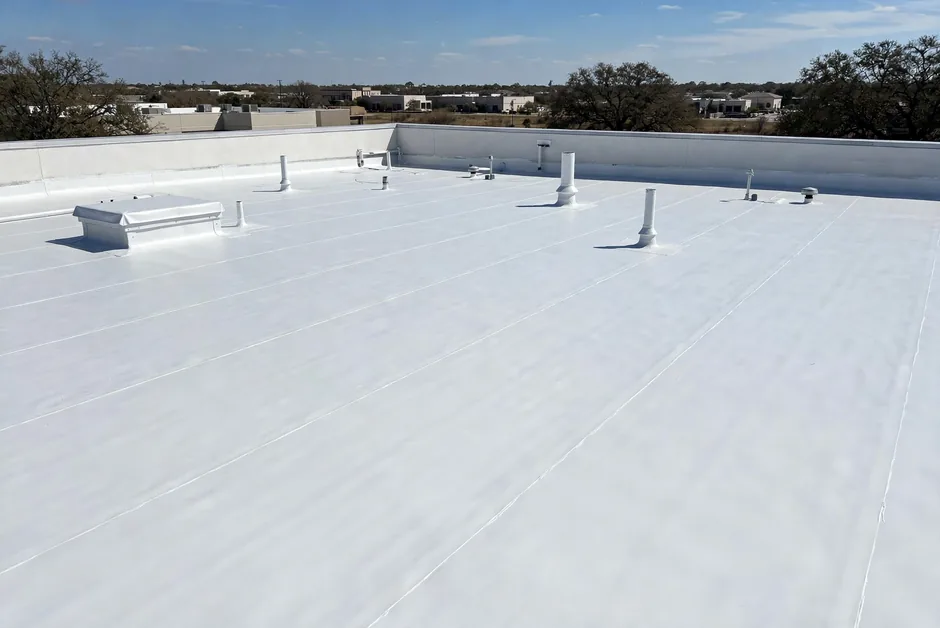
We walk the roof, check the deck from underneath, measure the area and map the drainage for the TPO install: where water goes now, and where it should go.
Fuses TPO seams into one continuous sheet. On a low-slope roof a welded seam is the strongest joint there is, when it is welded properly.
Rolls each TPO seam as it is welded and probes it after, so a weak seam is found on the day it is made, not in the next rain.
Before the new TPO goes down, the meter finds wet decking under the old membrane, so soft sheets come out instead of being roofed over.
Cuts TPO membrane and flashing cleanly at edges, penetrations and terminations, where a ragged cut becomes a leak.
Tie-offs on every roof, low-slope included. A low pitch is still a fall from height, and a white TPO membrane is slicker than it looks underfoot.
We sweep the ground below when the job is done — fasteners and TPO offcuts left lying around are a hazard on their own.
Ponding after every heavy rain can open the seams at the edges of a low-slope TPO section — the water sits there longest, and the seams give way first.
What we do: redesign the drainage path, replace the soft decking, and install TPO with heat-welded seams and new edge metal, so water sheds rather than sitting.
Book this service →Where a flat TPO section meets a pitched roof, wind-driven rain can get in at the joint.
What we do: re-flash the tie-in, re-grade drainage across the flat section, and fit TPO with welded seams plus new wall flashing at the joint.
Book this service →A garage roof already patched twice, with water still ponding at the drain and a soft deck underneath, is usually ready for a full install rather than another patch.
What we do: an honest read first, then a full install: drain re-set, soft deck replaced, and TPO with welded seams.
Book this service →Most low-slope failures in San Antonio announce themselves long before the ceiling stains: seams opening in the heat, ponding that never dries, flashing pulling at the edges. These are the TPO failures that turn up most often, and what they cost if they are left alone.
Ask a pro →Thermal movement opens seams that were not detailed for it. We weld seams and probe them as they are laid, so a weak weld is found on the day.
Standing water works at TPO seams until they fail, so drainage is designed first and the roof sheds water instead of holding it.
The deck gets inspected before any new TPO covers it — a fresh membrane over a bad deck hides the problem until the deck itself fails.
On a TPO roof the leaks start at edges and penetrations, not in the field — so new edge metal and flashing go in throughout.
“Found their ad on marketplace, super quick feed back. Gentlemen stopped by same day to inspect roof. This company is extremely professional and quick. They had our roof done in 2 days. Great price point and easy to work with. Thank you Juarez Contracting.”
Alethia VelazquezGoogle review
“Chris was professional, on time for the estimate, very informative about what needed to be done,and willing to work with me. Thank you for a job well done.”
Belinda SalinasGoogle review
“Very fast estimate and fixed within 24 hours of asking them for help. Very fast and very reliable. My roof looks great!”
Jamie KGoogle review
TPO membranes realistically last 15 to 25 years here. The failure mode is usually seam failure from thermal movement or ponding, not the membrane wearing through.
They are different systems for the same job. TPO is a single-ply membrane with heat-welded seams and a reflective surface. Modified bitumen is a layered asphalt-based membrane with sealed seams. The right choice depends on the roof's slope, drainage and foot traffic.
A TPO roof replaced or installed inside San Antonio city limits needs a City re-roof permit. The flat fee is $28.75, which comes to $31.05 with the City’s two 4% surcharges for an online filing. We prepare the paperwork through BuildSA.
Because the drainage is not keeping up with the roof area, or the slope to drain is too shallow for a TPO system. We map the water path and fix the drainage as part of the install, not just the membrane.
Call (254) 329-0299 during business hours for a low-slope inspection with a drainage plan and a written scope.
Call (254) 329-0299 →Call us at (254) 329-0299 or send an email. We answer the phone during business hours and return after-hours messages first thing the next business morning. TPO inspections are by appointment.