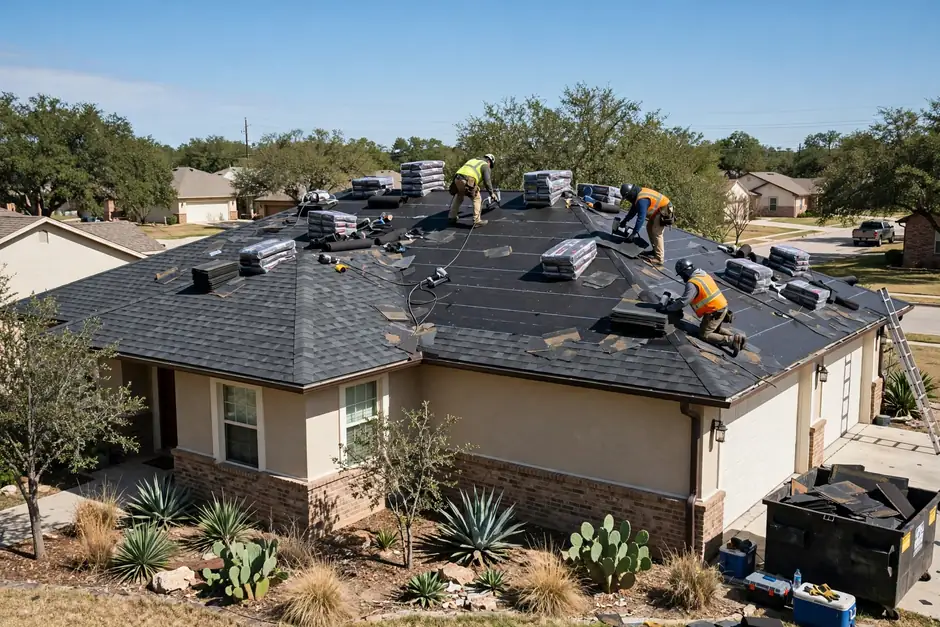
Full tear-off to deck
Everything old comes off to the sheathing on a replacement, and every sheet is checked — soft ones are replaced before anything new goes down.
Architectural asphalt is the dominant roofing material across San Antonio. Most homes in the city have asphalt shingles, and architectural shingles are the standard replacement. In this heat they realistically last 15 to 20 years, not the 25 to 30 years on the manufacturer's rating. South- and west-facing slopes age first. The granule loss in your gutters is the clock, and a Class 4 impact-resistant shingle is the upgrade path when hail is the worry.
Heat and UV break asphalt down. UV breaks the binders and drives the flexibilising oils out, so shingles curl, crack and go brittle. Granules are the shingle's sunscreen: once they shed, the bare asphalt ages faster. Attic heat cooks shingles from below, and daily thermal cycling loosens seal strips and fasteners over thousands of cycles. That is why a 25 to 30 year rated shingle realistically lasts 15 to 20 years here, and why a 3-tab shingle, the older builder-grade default, lasts 12 to 15 years.
The 1990s and 2000s tract builds across the city were mostly 3-tab or early architectural shingles, and most of those roofs have already been replaced once. A 1990s home in 2026 is on its second or third roof. When we quote shingles, we quote the realistic life, the south and west slope ageing, and the Class 4 upgrade path, so you can decide with the real numbers in front of you.
A shingle roof is a system, not a surface. Everything below is part of our written scope as standard, so you know what is included before you decide.
Everything old comes off to the sheathing on a replacement, and every sheet is checked — soft ones are replaced before anything new goes down.
The field gets synthetic underlayment, valleys and eaves get self-adhering membrane — the layer that keeps water out when a shingle fails.
Walls get step flashing, penetrations get pipe boots, and the perimeter gets new drip edge. Most leaks start at old flashing, so we do not reuse it.
The ridge vent is sized to the roof area and paired with soffit intake — proper attic ventilation is what keeps a shingle roof from cooking itself from underneath.
Where a permit is needed we prepare the City re-roof paperwork, and the job closes with the City's final building inspection.
We walk the roof, check the deck from the attic side, read the granule loss and curling, and give you an honest repair-versus-replace read.
Architectural shingle options are set out on the written scope, including the Class 4 upgrade path, so you can compare them side by side.
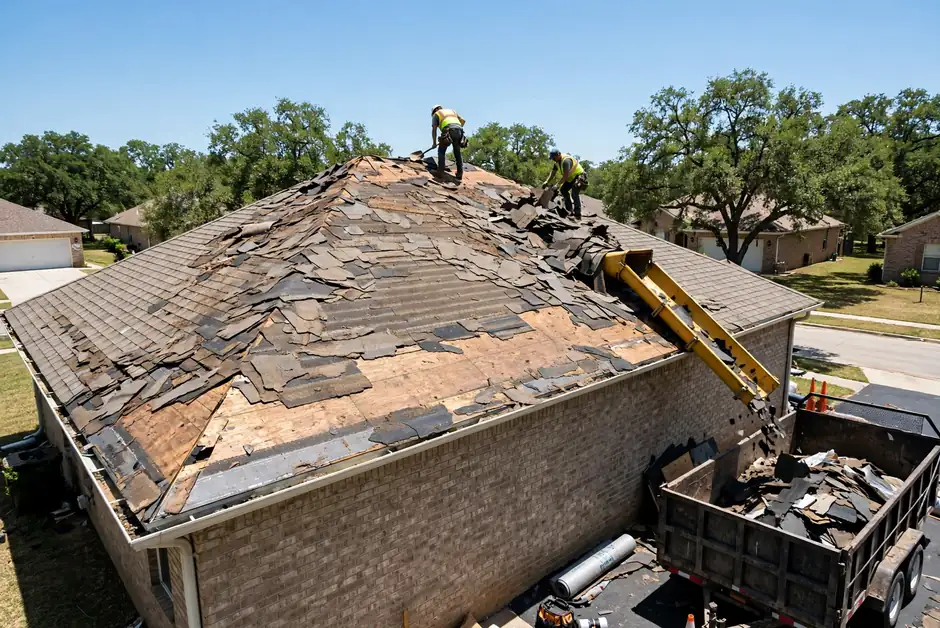
The old roof comes off and any rotten sheathing is replaced on the spot. We do not shingle over soft deck, ever.
Underlayment and valley membrane go down, new flashing and boots are fitted, and the shingles go on to the manufacturer's pattern.
The roof is cleared, the gutters swept, the magnetic sweeper run across the lawn and driveway — and the finished roof walked with you.
We walk the roof, check the deck from the attic side, read the granule loss and curling, and give you an honest repair-versus-replace read.
Sets fasteners at the depth and spacing the manufacturer specifies. Every course gets a hand-check, because a nail driven too deep tears the shingle it was meant to hold.
Trims shingles cleanly at valleys, hips and rake edges. The details are cut by hand, and that handwork is what makes a roof look finished instead of rushed.
For tear-off and detail work, the pry bar lifts old shingles without damaging sound decking, and the knife cuts underlayment and membrane to fit.
Snaps the reference lines the shingle courses follow. Straight courses are not about looks; they are the visible proof the roof was laid to spec.
Harnesses and tie-offs on every slope, no exceptions. Nobody goes up without fall protection, and no ladder goes on a slope it cannot sit safely on.
Reads wet decking and hidden leaks from inside the attic, so any soft sheet is swapped out before it gets roofed over.
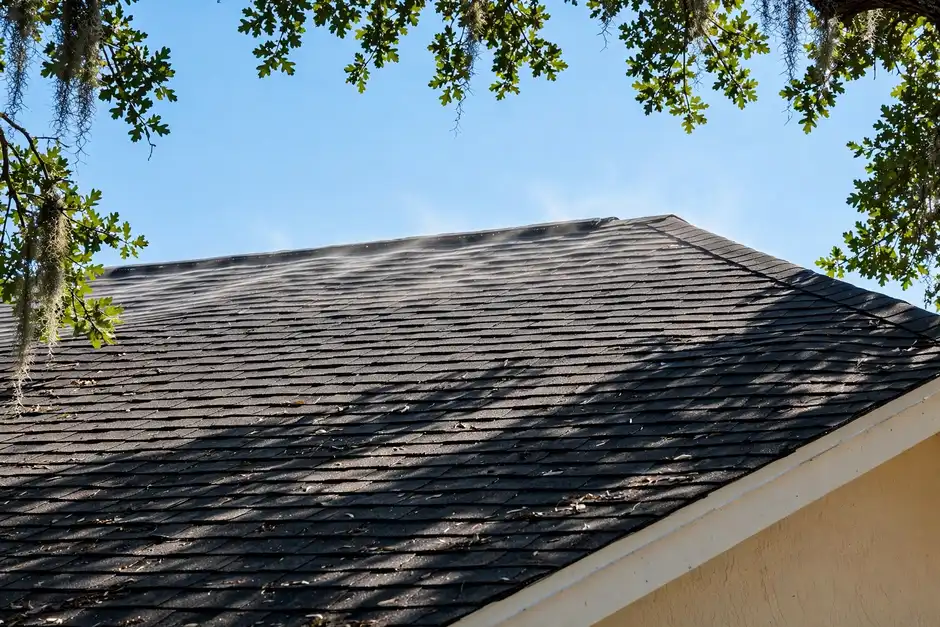
A home still on its original shingles — granule loss in the gutters, curling on the south slope, and leaks — is ready for a full tear-off and a new architectural shingle system.
What we do: full tear-off to the deck, soft sheets replaced, new underlayment and valley membrane, and a new architectural shingle system with new flashing and ridge ventilation.
Book this service →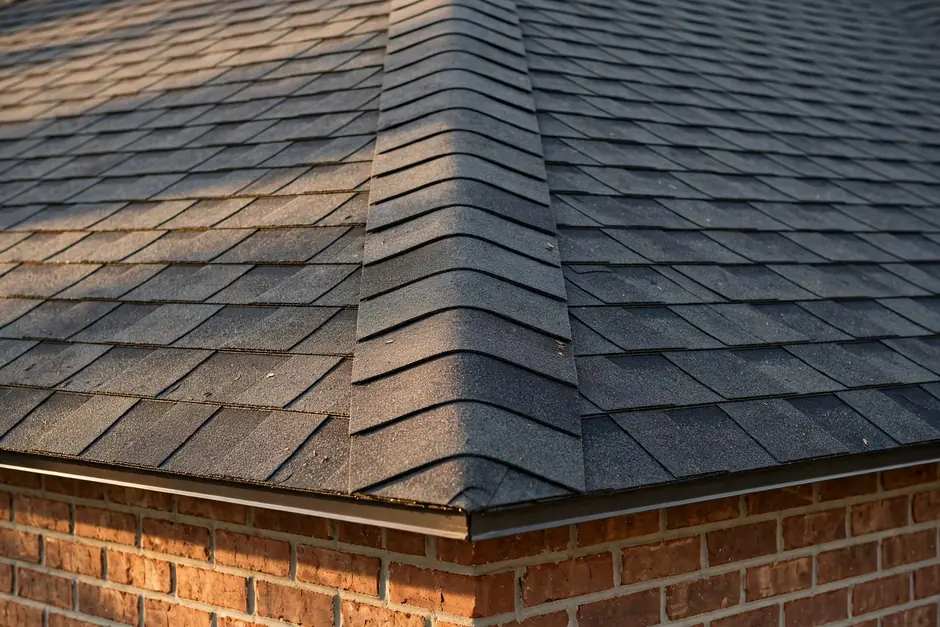
A ranch with builder-grade 3-tab shingles long past their realistic 12 to 15 year life is ready for an architectural shingle rebuild.
What we do: tear-off down to the deck, deck repairs in the valley, and a complete architectural shingle rebuild with new flashing throughout.
Book this service →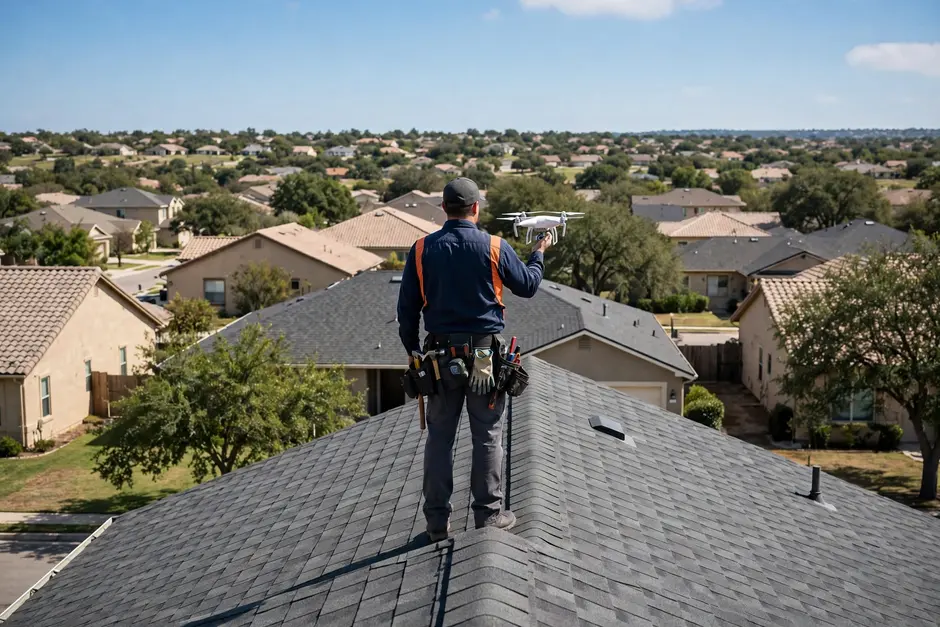
A home that has replaced shingles after hail may want the next roof to stand up better to the next storm.
What we do: an honest read on Class 4 shingles, including that the insurance discount is set by the insurer, then a full install with impact-rated architectural shingles.
Book this service →Shingles in this heat fail in a handful of familiar ways: granules washing into the gutters, curling on the south and west slopes, a three-tab roof past its life, or seal strips that have given up to heat and age. These are the shingle problems we see most, and what happens when each one is left to spread.
Ask a pro →Granules are a shingle's sunscreen. Once they shed, the bare asphalt ages fast. We read the loss as the roof's age clock and tell you how much life is left.
Afternoon sun ages south- and west-facing slopes first. We check those slopes separately, because a roof does not age evenly.
Builder-grade 3-tab realistically lasts 12 to 15 years here. We tell you when a patch is money spent twice and replacement is the honest answer.
Heat and thermal cycling break the seal bond, and wind finishes the job. We check the seal on the affected slopes and re-seal where it has failed.
“Found their ad on marketplace, super quick feed back. Gentlemen stopped by same day to inspect roof. This company is extremely professional and quick. They had our roof done in 2 days. Great price point and easy to work with. Thank you Juarez Contracting.”
Alethia VelazquezGoogle review
“Chris was professional, on time for the estimate, very informative about what needed to be done,and willing to work with me. Thank you for a job well done.”
Belinda SalinasGoogle review
“Very fast estimate and fixed within 24 hours of asking them for help. Very fast and very reliable. My roof looks great!”
Jamie KGoogle review
Architectural asphalt realistically lasts 15 to 20 years here, against a 25 to 30 year manufacturer rating. 3-tab shingles realistically last 12 to 15 years. Heat, UV and attic heat shorten the life against the lab rating.
3-tab is a single-layer shingle and was the older builder-grade default. Architectural shingles are laminated, thicker and longer-lived, and are the standard replacement across the city now.
For hail country, often yes. They are rated to UL 2218 for impact resistance. The insurance discount question has to be answered honestly: any discount is set by your insurer, company by company, and we do not quote a percentage.
Afternoon sun. South- and west-facing slopes take the most direct sun and the most heat, so their shingles lose oils and granules first. We inspect slopes separately for exactly that reason.
Call (254) 329-0299 during business hours for a shingle inspection with a realistic life read and a Class 4 upgrade option.
Call (254) 329-0299 →Call us at (254) 329-0299 or send an email. We answer the phone during business hours and return after-hours messages first thing the next business morning. Shingle inspections are by appointment.